
Britain's highest mountain is an achievable climb and worth the effort for the marvellous views.
| Distance: | 10.3 Miles | |
| Est. Time: | 6 hrs 20 mins | |
| Difficulty: | Moderate | |
| OS map: | Explorer sheet 392 | |
| Total Ascent: | 4301 ft | |
| Total Descent: | 4308 ft | |
Register to create & share your own walks
Highlights
 The highest point in the British Isles (4406 feet)
- Snow, even in midsummer
- Magnificent views of Loch Linnhe and the surrounding mountains
- Variety of birds and wildlife
Ben Nevis is the highest mountain in Great Britain. The summit is sufficiently high to hold a permanent snowfield. Even in summer the temperature is likely to be below zero at the summit. The challenge is rewarding and the views can be magnificent on the way up and down.
The Route 
Start at Glen Nevis main car park (GR 123732). The Visitor Centre is at one end of the car park. The route begins from the other end.
Cross the footbridge and follow the path beside the river before turning left and climbing beside the wall towards the farm. After about a half a mile (GRI26729) you join a more gentle terrace path climbing gently up across the side of Glen Nevis. This is the obvious as there are no other main tracks.
The path swings left (north) to climb more steeply along the flank of Red Burn (a ravine). Skirt the top of Red Burn, crossing a stream, before swinging back southwards and onto more rugged screes (start of "zigzags").
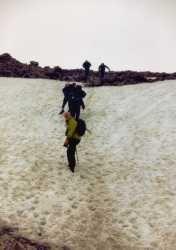
Gradually the slope eases, and you may now see some snow. Stay on the main path, and follow the obvious route with small stone cairns in the snow. If in doubt, keep on the southern edge of the snow and do not be tempted towards the left, or North Face, which can be very dangerous. The sharp drop is sometimes concealed by mist. After several hundred yards on fairly flat snow and scree, you will see the remains of the weather station and the summit cairn off to the left (North).
Retrace the same route to Glen Nevis, taking particular care as you leave the plateau itself.
Safety
Ben Nevis claims four lives in the average year and must be taken seriously. Equipment is important - you may well sweat on the way up only to find that you rapidly lose heat at the summit, so windproofs are essential, as are good walking boots. The ascent will take over 3 hours for fit walkers and the return journey will not take much less. Most people should take it steady and allow the whole day.
Notes
Fort William is the largest town is this part of Scotland and has a wide range of facilities, including hotels, guest houses and B&Bs, plus restaurants, takeaways and shops. It is a centre for tourism but also for walking and climbing, with at least 3 well-stocked stores with outdoor clothing and equipment. It was fortified during times of conflict with the English, which was when it gained its current name.
Ben Nevis is Britain's largest mountain, with a height of 4,406 feet above sea level. The car park and Visitor Centre is not far above the level of Loch Linnhe, so the climb begins almost at sea level. This mountain is small by international standards and the popular route is along a relentless, but safe and steady path. However, it is not to be taken lightly. it has an alpine microclimate at the summit and can be at sub-zero temperatures in midsummer. On average, 4 people a year die on this mountain. The name 'Nevis' is very old and its origin is not fully known. It is known that the river Nevis was named first and the mountain was named after it.
Loch Linnhe is the sea loch into which flow the River Nevis. Fort William stands on one side of the Loch and passenger ferries ply from the quayside to serve routes towards the inner Hebrides.
Red Burn runs through a small gorge down into the River Nevis. Once you cross Red Burn, via a wooden bridge, you round a bend to catch your first clear view of Ben Nevis itself.
River Nevis is the wide stream that runs beside the car park and Visitor Centre. It flows through Fort William and into Loch Linnhe.
The Munroes are Scotland's mountains above 2,000 feet, numbering about 200 peaks, with Ben Nevis as the highest and several more grouped closely around it. Some people adopt the lifetime challenge to climb them all!

